On March 11, 2026 I started moving this site to a new web host. You may see some strange things and broken content the next few days as I muddle through!
Blog
-

Is Mt Seymour the best beginner backpacking spot?
This site may contain affiliate links. If you buy something, I may earn a small commission at no cost to you.
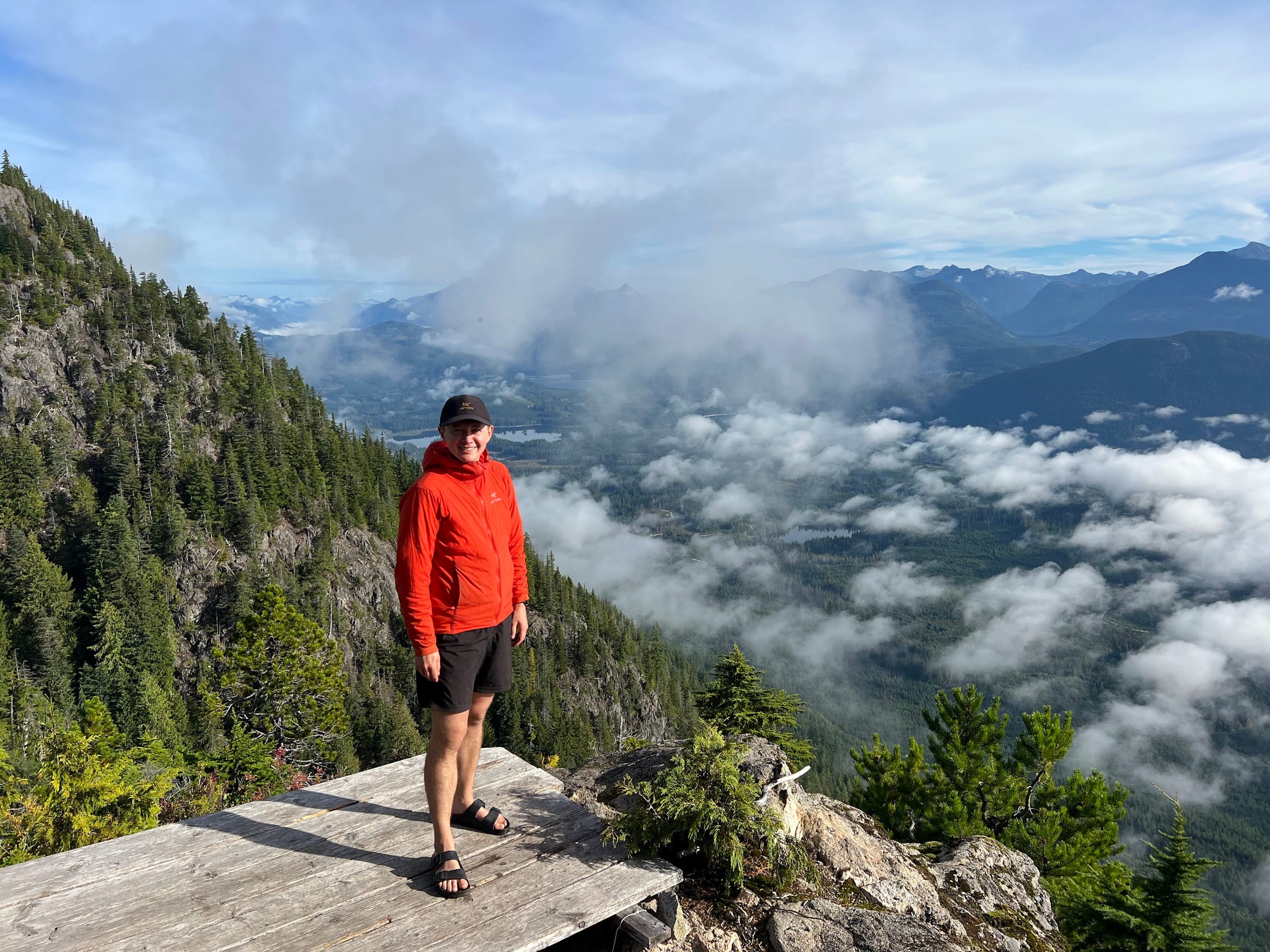
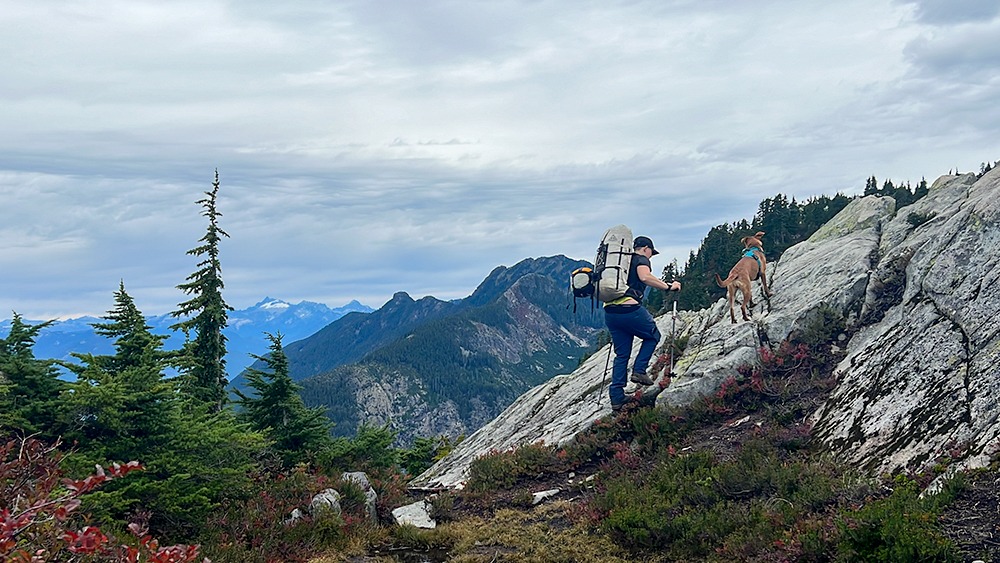
We headed up Pump Peak on a hot Friday night in July for a night of backpacking. Pump Peak is the first bump you hit on your way to summit Mount Seymour and is a popular backpacking spot.
It was our puppy Jasper’s first-ever backpacking trip and my first backpacking trip in years after a serious illness.
It’s 7km long with 450m elevation gain, which is relatively “easy” compared to most backpacking trips in the area. No permits or reservations are required. And it’s a short drive from Vancouver. This made it a fantastic beginner backpacking trip for us!
It’s not perfect for all beginners, as there are no facilities, like an outhouse or food caches. So you need to come prepared!
- There are definitely bears in the North Shore mountains and there are no trees tall enough on Pump Peak to do a bear hang. We used an Ursack to keep the bears safe and away from our food. You might also use a plastic bear can.
- For water, we treated what we found in streams and tarns using my Katadyn BeFree squeeze pump.
- And pooping in the backcountry is its own art.
There were a few other tents up there when we camped, which didn’t feel very busy. The bugs were pretty horrible, which may have kept the crowds away.
Pump Peak is extremely busy on the weekends, so it’s not a fun place to linger in the morning. We got up, tagged Tim Jones Peak and Mt Seymour and then made our way down to the car.
-

Mountain Voices: Creating Our Own Mountain Culture
So excited to have a story I wrote published in this new book, Mountain Voices!
Mountain Voices is about a century of change in the mountains of Western Canada through photography and stories.
My story talks about how I found my own way to approach mountaineering as queer/trans person who does not fit into the dominant hypermasculine culture in the outdoor industry.
Me and others (including many men!) prefer a more caring, emotionally safe space where you can be yourself and no one is left behind. This is often not what you find in a random outdoors meetup or guided groups, where getting to the top is prioritized over all else.I don’t think the two are mutually exclusive. I think you can still accomplish amazing things, even while everyone feels physically and emotionally safe.
My experience of leading a trip up Mt Shuksan via Fischer Chimneys is one of the experiences I drew from when I wrote my story for Mountain Voices. (And I’ve written quite a lot more about gender and climbing/adventuring, if this resonates!)
-

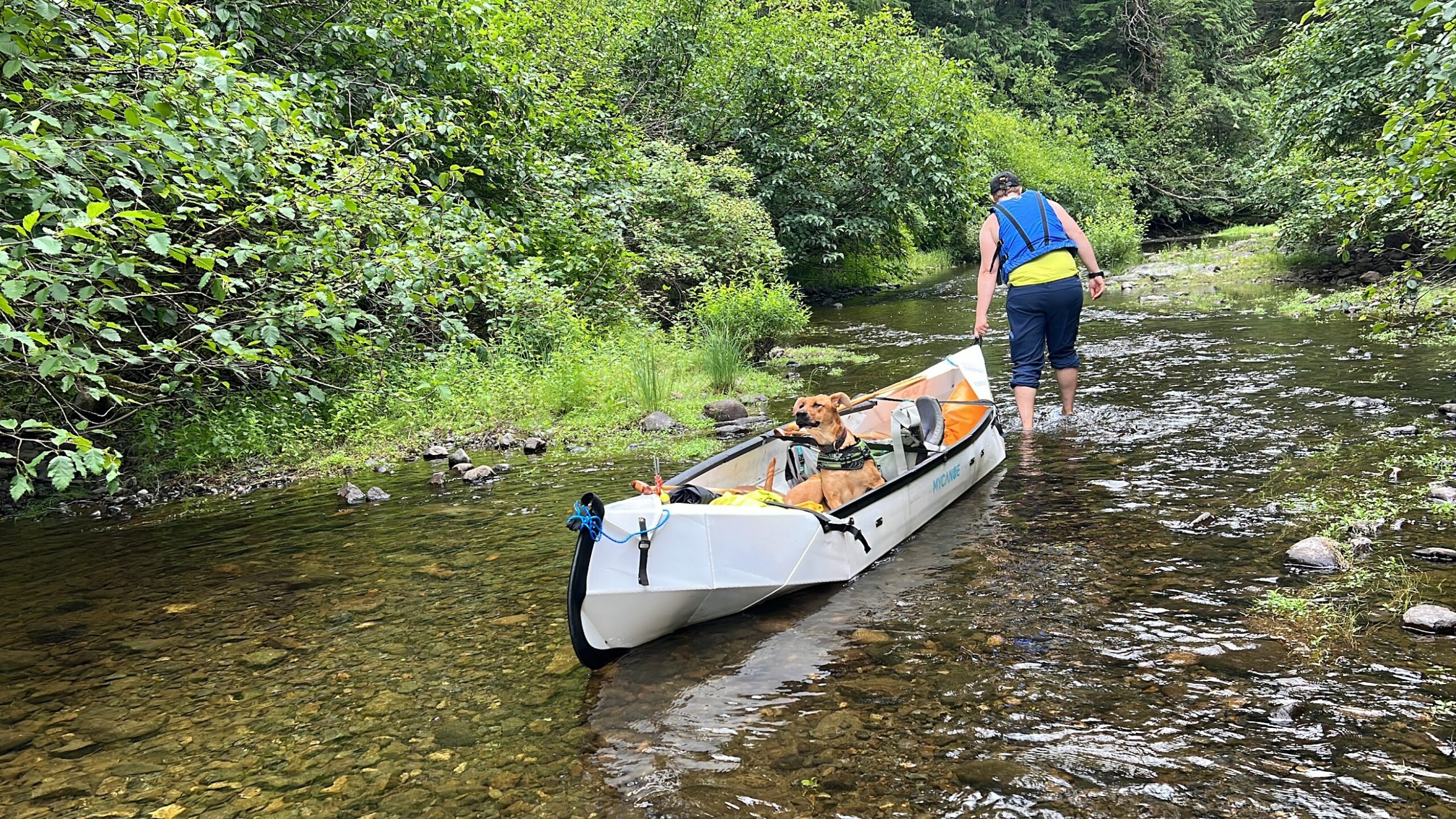
Taking a folding canoe on the beautiful Sayward Forest Canoe Route
The Sayward Forest Canoe Route is a nearly 50km canoe circuit on northern Vancouver Island. We ventured out with our puppy Jasper in some incredibly rainy weather. We dealt with a broken canoe cart, bushwhacking through streams, navigating beaver dams and all the fun that comes with a Vancouver Island backcountry trip! It was a beautiful experience and one I would recommend. Enjoy our video trip report to get a taste of what the route and campsites look like.
Fast facts
- Distance: Approximately 39km of paddling, 8km of portage. (Remember if you can’t carry your canoe and camping stuff in one trip, you will walk each portage three times so it’s like 24km!)
- Time: 3-5 days
- Nearest town: Campbell River
- Launch destination: Morton Lake Park
- Parking at the trailhead: Free and plentiful
- Reservations required: None
- Camping fees: None
- Best campsites: Look for marine-only campsites, as anything accessible by road will likely be taken in the summer even during the week. We stayed at Bedrock City on Goose Lake, Sterling Beach on Amor Lake, Fry Narrows on Fry Lake and Mohun Island on Mohun Lake. Mr. Canoe Head also looked large and inviting.
- Map: PDF
Paddling with a puppy
Jasper looks pretty calm in this video. This is because we cannot film her when she’s being a little monster. (Our hands are full!)
But honestly, most of the time she is very good in the boat. With everything dog-related, it’s taken a lot of work to get there!
We immediately took Jasper out in our canoe when we got her as a three-month-old puppy. And we kept doing short trips with her over and over again — making it a positive experience as best we could, with lots of treats and rest breaks on land to play.
Her training did not go perfectly. She dumped Lee in the middle of a cold alpine lake once and they had to swim to shore. Everyone was wearing life jackets, most importantly Jasper! And whenever Jasper gets into the boat after a long time away from it, she tries to lean out of the boat and bite the water and just wiggles all around.
To deal with this, we just lower our expectations of how fast we are getting anywhere. One of us usually has to distract her and watch her for a while, making sure she stays in the boat. Then eventually she gets it, calms down and just chills. She also gets quite a lot of exercise in general (several hours per day, every day) so she is a calm dog who is used to settling down when it’s not go time.
Sayward Forest Canoe Route vs Bowron Lake Canoe Circuit
Bowron is a very popular canoe circuit near Prince George in northern BC. It’s over twice the distance of the Sayward Route and requires reservations far in advance. There is also a lot more structure and support. With Bowron you must attend an information session taught by park rangers. They weigh your gear to see if you’re portaging too much. There are cabins and covered picnic structures everywhere to help you shelter from bad weather. There are also emergency phones so you can call rangers if you get into trouble. There are outhouses and bear caches everywhere.
Sayward is a true backcountry experience in that you have no support, sometimes no outhouses and definitely no food caches. It doesn’t always feel very remote though, as you are paddling by people in their RVs who drove to campsites from nearby Campbell River!
Overall, I prefer Bowron over Sayward because of the truly remote feeling. But the logistics for Bowron are not simple and the trip itself takes twice as long. So Sayward will do the trick if you need a shorter, easier canoe fix!
-

Ultimate Paddling and Hiking Adventure to Cirque Lake
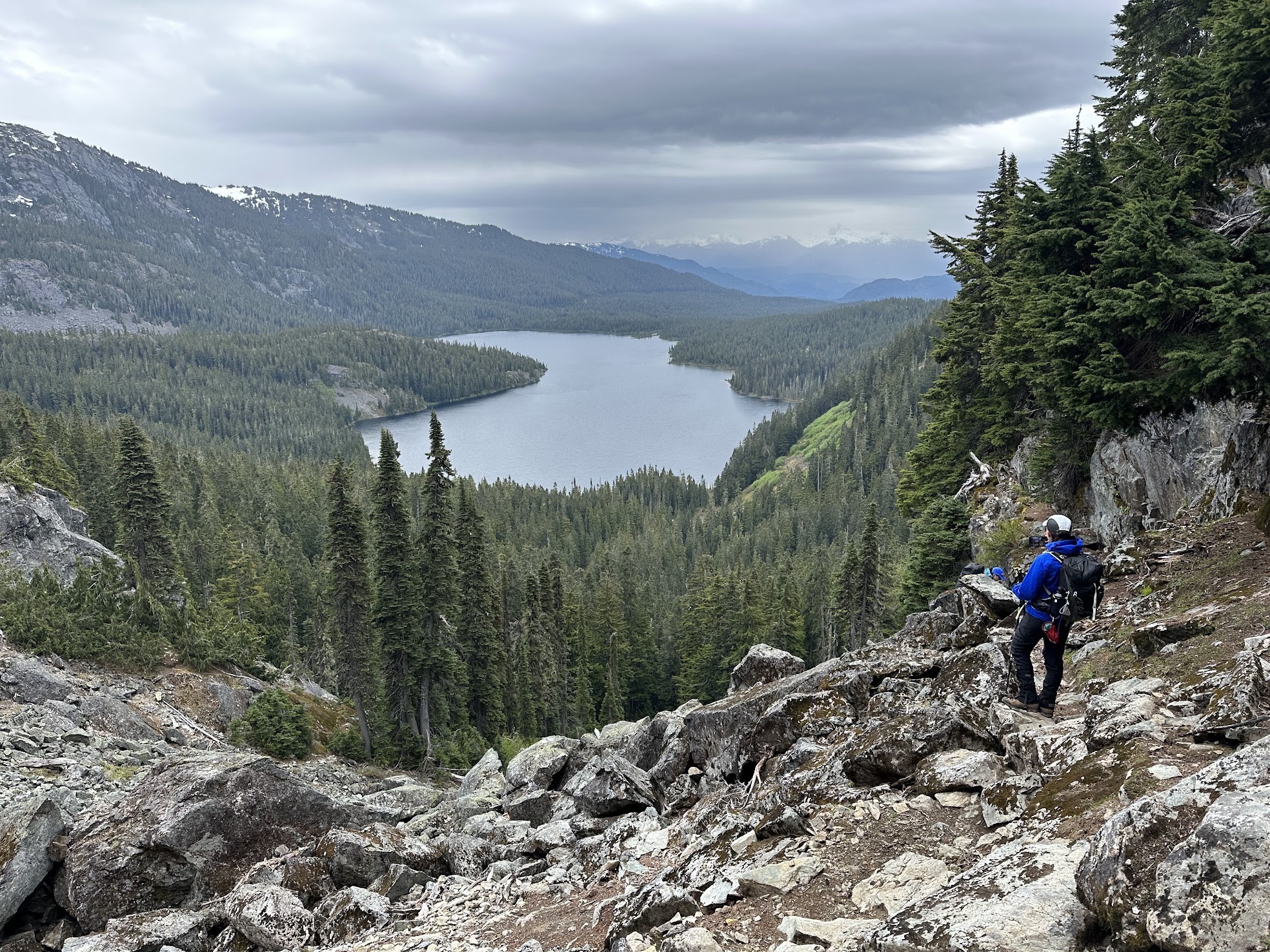
We ventured out to Callaghan Lake near Whistler, BC in late June to make our way up to the beautiful alpine Cirque Lake. The trailhead to Cirque Lake is only accessible by boat, so we brought our trusty folding canoe with us.
Driving and Camping
We had two surprises on our way up there.
First, we were delighted to find multiple spots still available Friday night at the Callaghan Lake Rec Site. But the forecast wasn’t so great, so that may have been why.
Secondly, we saw a grizzly bear! I have never seen one in my life in the wild and I imagine I will never again.
The road is a forest service road and all gravel. It’s mostly in good shape, except for the medium-sized water bars. We drove our truck and I imagine a two-wheel drive car would not make it.

Paddling
We set up our folding canoe and then were off on a calm paddle across Callaghan Lake. Jasper (our puppy) is still learning chill in a canoe and had dumped us out of the boat recently. So we carefully waterproofed everything inside our hiking bags and attached our bags to the boat incase we went for a swim. But luckily, we did not.

Hiking
The hike is only 3km long with 354m of elevation, but it’s steep and challenging. There is a large section of talus and boulders that is a bit tricky to navigate. Once we got into the alpine, we were mostly met with snow. We did not use microspikes, but I did have on gators and waterproof boots.
Want to learn more? Watch our video trip report! Please remember to like, subscribe and share.
-

Climbing the Goat: Lessons learned from one of the longest sport climbs in North America
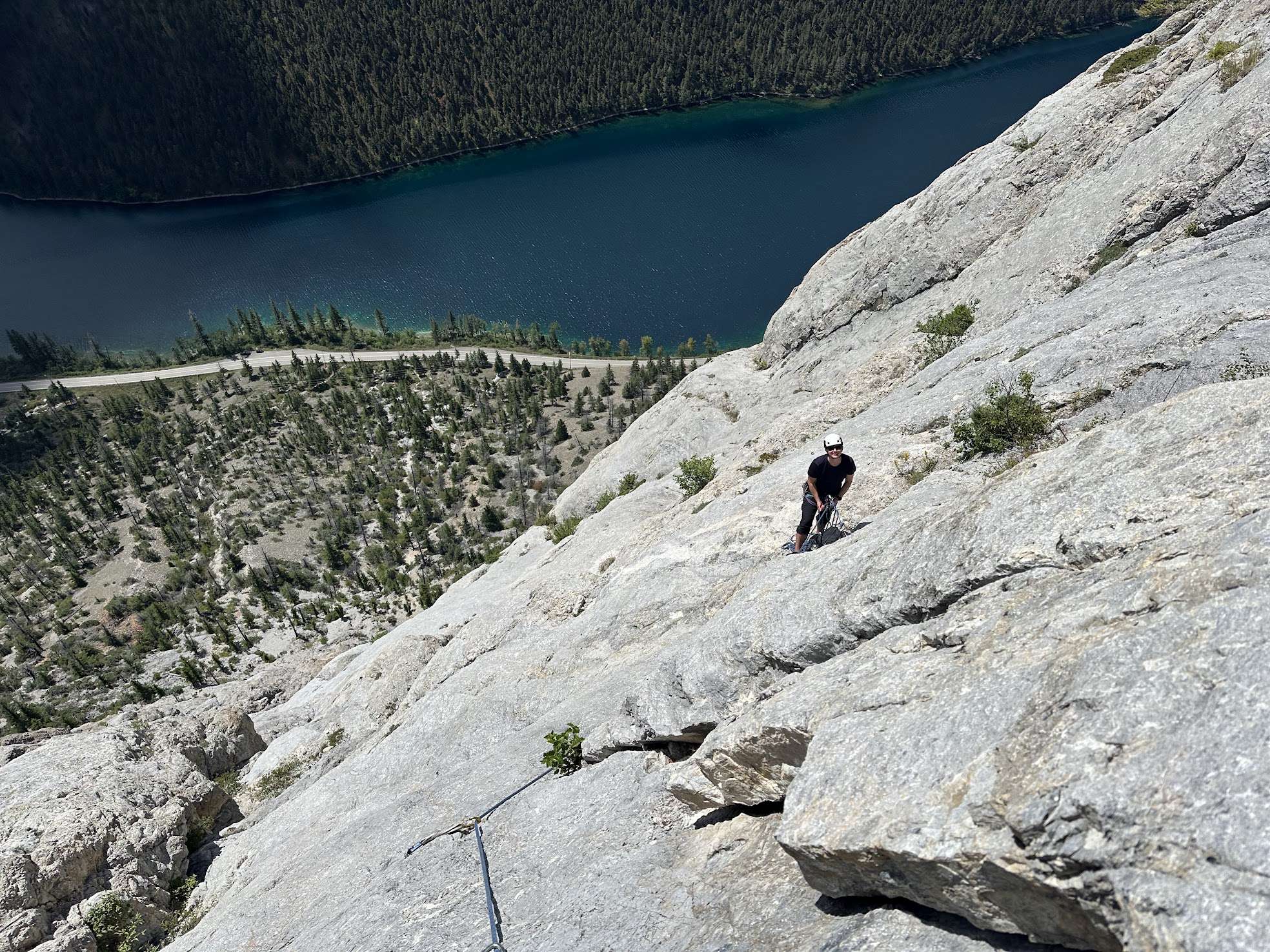
The Goat is a 650m (2100ft) climb in Marble Canyon, about an hour outside of Kamloops. It is 19 pitches long and is a 5.9.
For Squamish friends, this is about the same as the longest routes up The Chief. For non-climbers, this is much taller than the tallest skyscraper in North America (One World Trade Center in New York).
It’s alpine-style limestone slab climbing, which is quite different than most of the climbing you might practice in the gym or even in Squamish. There are a lot of loose rocks that can hurt or kill people below you if you knock them loose accidentally.
Slab climbing relies a lot on friction rather than grabbing onto things with your hands or resting your feet on little ledges. Limestone can become polished, which means it can feel slippery as it’s climbed more over time. It is sort of like you’re trying to pad up there like a little gecko on rocks that may feel like glass at times.

The Goat A lot of the stories I see online are written by very good climbers. Confident people who run up there in a few hours using techniques like simul climbing. They make it seem like a warmup. Easy!
But for me, an average climber, it was pretty darn challenging! I had a hard time! I was nervous! We were careful! It was a big deal!
So with that, my humble story of an average person, climbing The Goat.
Preparation
I started climbing about fifteen years ago, and it has been a central part of my life ever since. However, I hadn’t climbed much in the past two years due to long covid. So this summer, Lee and I were on a mission to climb outside as much as possible and as hard as possible.
After a few months of climbing two or three times a week, we were both confident onsighting 5.9. (Onsight means you climb something without knowing anything about it or having tried it ever before.) Lee is stronger and can get up harder stuff than I can.
We also started climbing many multipitches to become as efficient as possible with our rope management skills. We climbed a few short multipitches in the Rockies that were a similar limestone slab style. We also tackled 100 Zulu and Western Harlot in Squamish. The last multi we did before The Goat was Throne of Kings, which was the longest climb I had done to date… but only a third of the height of The Goat.
Camping
We drove up to Marble Canyon ahead of our scheduled climbing day. We spent Saturday night in Cache Creek, enjoying some amazing tacos.
On Sunday, we moved to the Marble Canyon rec site, which has first-come, first-served camping. There were tons of spaces on a Sunday.

Excellent Sunday night rec site at Marble Canyon We chose to climb on Monday rather than the weekend, as we had read about the serious rockfall danger. This proved to be an excellent choice!
From the highway, we were able to watch people climb. We saw two groups bunched up together about two-thirds of the way up, where the more difficult climbing started. We saw one party coming down (rappelling) while another party was climbing. It happens sometimes… but yikes! Scary!
There were several cars in the parking area, meaning there may have been even more parties ahead or behind we didn’t see.
After feeling confident in our decision to climb on a weekday, we went back to the campsite. We got our food and gear ready. We practiced some rock rescue skills. And then we rested.

Some relaxation before the big day Our alarm clocks were set for 4:00am the next day.
Climbing
We parked around 5:45 am and started climbing around 6:15 am. I think on a weekend, this would be considered a late start. But we mostly were trying to beat the sun, rather than the crowds, so this was our compromise to get a bit more sleep.
The first two pitches were surprisingly polished (aka smooth). It actually freaked me out a bit, and I almost told Lee we should just turn around now. But then I realized, we could turn around whenever we wanted. So might as well keep trying.

Lee looking confident and me looking nervous Pitch three felt a bit better. And the rock kept getting better the higher we went.


The distance between the bolts felt safe most of the time for our ability level. I think if you were a newer leader or not a confident 5.9 leader, it might feel pretty spaced out and scary. For example, some of the easier pitches only had three bolts on them over 30m. This would not keep you from getting hurt in a fall, but would keep you from rolling down the mountain. So it wasn’t terrifying like Star Chek, but also wasn’t a bolt ladder like Frontside 180.
The final pitch was “third/fourth class” and had no bolts or anchor. I found it fine, but depending on your experience in the alpine, you may not.

Lee making her way up a higher pitch There are three 5.9 pitches all in a row. The last one is the hardest, with some very blank slab sections. I did not lead it nor did I climb it cleanly, so it doesn’t feel fair for me to offer a differing grade. But it was quite a lot harder than the two 5.9 pitches that came before it. I can see how one might climb all the way up there and then need to turn around …
Overall, the climb took us 9 hours, or about 30 minutes per pitch. About half of this we did before we were in full sun.

Watching the hot sun creep closer Descent
I think I will only climb The Goat once because of the descent, which was horrible. After a short rappel, you have to hike down 30 to 45-degree dirt and scree. Mountain Project said it would take 30-45 minutes, but I am not sure how that is physically possible. (Running? Sliding uncontrollably?) We took 2.5 hours plus a long break because we weren’t feeling so great (see next section), but I think 2 hours is realistic for the average person.
If you could fit hiking poles in your pack, that might be very helpful. Also, I have never said this before … but I wish I had gardening or rappel gloves! The trees and bushes I wanted to grab for a veggie belay were full of prickles! My hand hurt quite a while after this climb…
The descent was also the most dangerous part of the day due to rockfall. While climbing, you might knock some little rocks loose that could hit someone. But in the descent gully, huge rocks just went flying straight down no matter how careful we were. This is definitely a one group at a time situation.
Having some tips on how to avoid rockfall in this situation would be very helpful. Here are some of the things I keep in mind:
- Keep your group really close together at all times. A slow-moving rock bumping your ankle could hurt a little bit. But if it had some distance to roll and really get going, it could hit your chest or head and seriously injure or kill you.
- Rocks might move even after you leave the area. Look for natural areas of protection and try to stay behind them, such as behind boulders, big trees, or spaces where the gully zigs or zags away from the center.
- If you want support, push down on rocks. Never pull on them. Even boulders that look too big to move will move when they are on dirt/scree.
Lessons Learned
I am an old pro at digging deep and pushing through in not-quite-so-technical terrain because of all my years of mountaineering and running. I learned I could do that with climbing, too! Climbing nine hours straight, no breaks, takes a toll on your body and your mind. But I kept going.
I also learned that climbing a route like this on a weekday was a fantastic choice.
The unfortunate mistake I made was underestimating how much water I needed. I am not used to operating in the desert or on really long multipitches where there is no way to refuel. If Lee hadn’t brought a little extra water and shared it with me, I would have been extremely uncomfortable. We were both very thirsty for most of the hike down, which did not speed us along. We found a little spring almost at the end of the hike, which we stopped at and drank from because we were sooo thirsty… even though the car wasn’t that far away.

Me enjoying the oasis I have so much admiration and respect for the folks who developed this climb. What a tremendous undertaking it would have been to bolt all of this!
-

Climbing a Throne of Kings: A hidden gem in BC
Throne of Kings (5.10b) is an eight-pitch climb near Lions Bay, between North Vancouver and Squamish. It has stunning views, fun climbing, and a long, steep approach that will keep the crowds away — for now.
The climbing started mellow with two short, easy pitches. Wonderful warmup.

Pitch three is where the fun begins with a very athletic 5.9. There are big jugs, but you’re hauling yourself up over an overhang. I am a pretty solid 5.9 leader and found it right on the edge of my abilities to onsite. It got my adrenaline going and was super fun.
Pitch four was short, only four bolts.

Then it was my turn on pitch five, a 5.8. It was one of the more enjoyable pitches of rock climbing I’ve experienced in a while. The bolts were a bit spaced out, so you had to think about what you were doing. But I felt like I was climbing a fun, wandering jungle gym.
Then came the crux pitch, a 5.10b. Most of it was pretty easy, similar to the 5.8 or 5.9 that came before it. But there was one very crimpy move that was quite hard.
Lee got it on lead, so good for her. I, for the life of me, could not haul myself up there after several tries. I was weighed down with our shared backpack containing our shoes, water and snacks, so that did not help.

The obvious line straight up has OK crimps but no feet. I considered exploring to the left like Lee had, but I was feeling a bit shy about my struggles as another party was coming in hot behind me. We figured out how to give me a little boost to get me the two inches I needed to move on. And move on we did!
I would caution that a leader cannot pull their way through the crux by hauling on a quick draw. Someone in your party has to actually lead the thing. I am not normally shut down by a 10b on top rope, so I do wonder if this one move was pretty stiff for the grade. Maybe the overall grade was rounded down to make up for the easier climbing around it.

The group behind us couldn’t get one of their climbers through the crux, so they ended up rappelling down from there. Knowing some rope rescue or aid climbing tricks might help if one of your party suspects they will struggle at the crux.
The other interesting thing to note is that the last bolt on the crux pitch is at the same height as the anchor. This can create some safety problems with your top belay if you don’t manage it properly. If you’re using an ATC, clipping this last bolt with a standard quick draw may rotate your belay device enough to stop it from auto-locking.
You can likely fix this by using an extended alpine draw. If you skip the bolt entirely, there is a chance that your second could have a big fall as they traverse over to the anchor … perhaps making it hard for them to get back on the climb under their own power. But these are just my thoughts. Climbing is dangerous. Hire guides to learn new things.

The last two pitches were a great cool down. Pitch seven was a bit slabby, which is not my favourite but ok, fine. Pitch eight was almost a walk with one bouldery move on it.
There is an amazing spot to have lunch at the top. We were joined by some giant mountain ravens who were eyeing up our gummy bears and chips.


Getting back down
And then the “scramble” down! What to make of this? As a mountaineer who has lately taken up climbing, this scramble does not rise to the level of fourth class for me. It’s a hike, steep for sure, but a hike. It reminded me of the Climb (Evac Route) under the Sea to Sky Gondola.
However, I think if you’re a climber who is used to walking from car to crag on a nice gravel path, this scramble down might be harder for you than the climb. Bring real shoes. And you can always rappel if you don’t like how the scramble is going…


Parking
The parking is along the side of the highway right after the Logger’s Creek bridge. (Before the bridge area has no parking signs, and you will get towed there!) Maybe three cars fit in total. AWD or four-wheel drive may help, as you’re in a ditch.

Time
It took us about an hour to hike to the base of the climb, as it was pretty much straight up. And an hour to scramble down to the base of the climb from the top. Then it took another hour to do the reverse hike down. We spent four hours climbing, with about 45 minutes of that waiting for the party ahead of us. And we had a nice lunch break.
So we were car-to-car in about seven and a half hours. This was by no means a speed run, but the party ahead of us and behind us were more or less going at a similar speed. So, the data suggest this is an all-day outing for the average climber.
-

Everything you need to know to visit Sloquet Hot Springs
We ventured out to enjoy Sloquet Hot Springs, a natural and undeveloped hot spring. It’s about a 4-5 hour drive from Vancouver and is located on the traditional and unceded territory of the Xa’xtsa First Nation.
We left Vancouver in the afternoon and spent the night at a beautiful rec site on Lillooet Lake. This gave us a chance to take our canoe out that evening and the next morning. Lee did a bit of fishing.


Lillooet Lake rec site The next day we drove up to the hot springs for the day. It cost a $20 entrance fee for the two of us which is the same as the campsite fee. It was a cool day so we left our dog in the car, as no pets are allowed near the hot springs.
The trail down is short and steep. Anyone who hikes regularly would probably feel comfortable, but it may be challenging for those who are unfamiliar with our West Coast landscape. Our video shows the trickiest parts of the trail so people can judge for themselves.
Near the pools there was a small changing area but no washrooms. You could cool down in the river, but it’s very fast-moving. There was a rope tied up to hang onto while you dip, but the river current is very strong.
The site is open year-round, but it’s effectively closed to most people once it starts snowing as the branch off the main logging road up to the hot springs is not plowed.

Which way do you drive, via Pemberton or Harrison Hot Springs?
Almost everyone drives via Pemberton. It’s a logging road once you turn off towards Lillooet Lake, but a relatively safe and smooth ride.
Out of curiosity, we took the less popular way back home and drove towards Harrison Hot Springs. We have a 4×4 truck in good condition and are experienced backcountry drivers. We found it rather stressful and slow-moving. Many signs were posted warning us that the road was unstable and that we should stay away from the edge, but often the road was scarcely wider than the truck. There was no one else out there if you ran into trouble, so you really need to be self-sufficient. That way is not a scenic drive or shortcut for most people. There isn’t any footage in the video of that direction, as we were quite preoccupied with driving!

-

The long way around: Spearhead Traverse
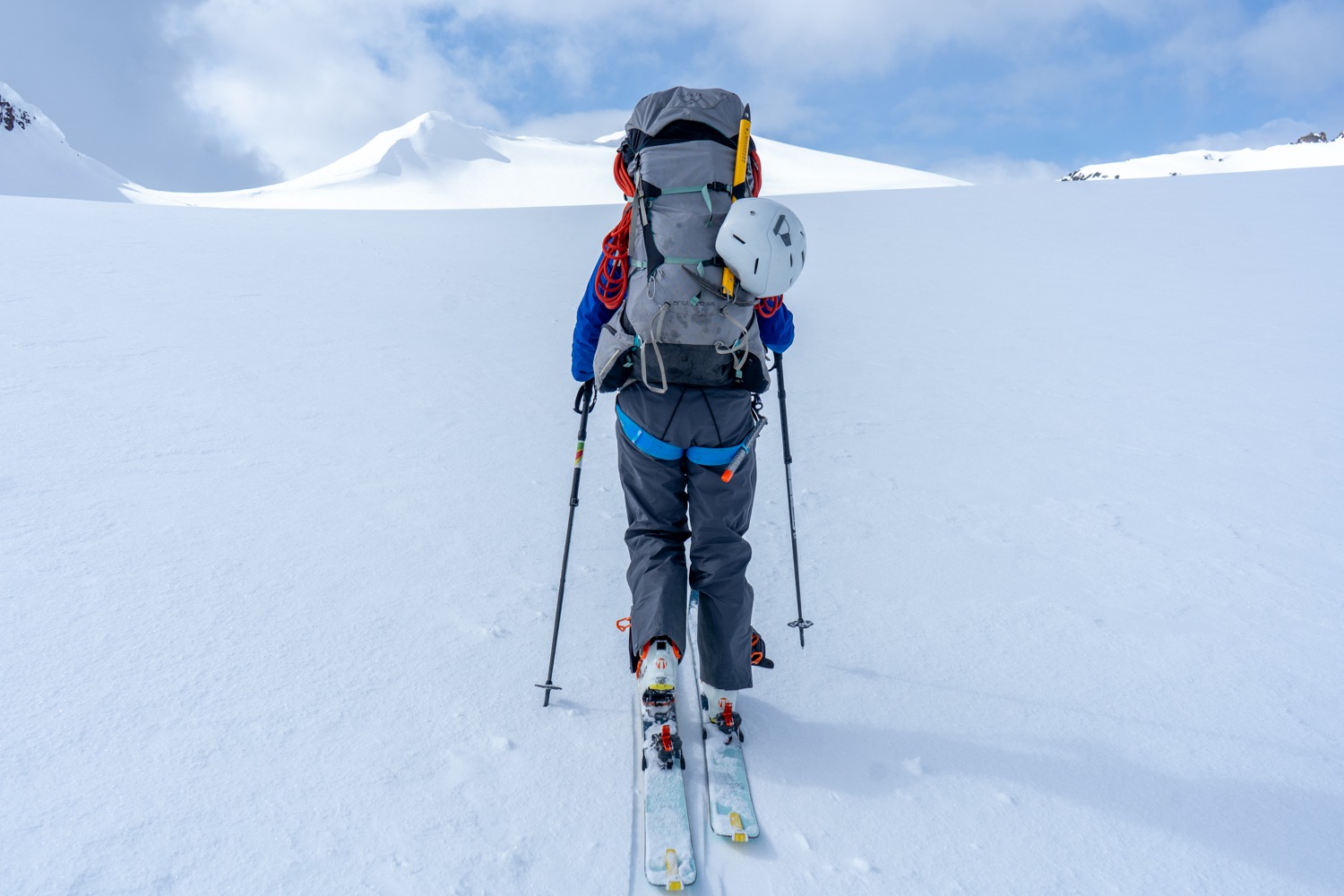
The Spearhead Traverse is a challenging ski mountaineering route that takes you from Blackcomb to Whistler, the long way around. It is a 35km traverse with approximately 1700m elevation gain. It connects 11 glaciers and 17 peaks.
You see a lot of stories of people doing the Spearhead in one day. Those people are outstanding athletes. But how would you, an average person and an okay skier, fair? And what if they went out in some not so great weather?
Well, this is that tale.
Lee and I are two middle-aged people who got a bit out of shape over the past few years due to the stress of a global pandemic and my subsequent two years with long covid.
We spent this winter lifting weights, running, and skiing as much as possible. We practiced crevasse rescue. I took two days of ski lessons. By the time we started on the traverse, I had over 30 days of skiing for the season. I was a strong black diamond skier on all terrain in the resort and comfortable with most terrain in the backcountry. Lee is a much stronger skier and can ski pretty much anything. We have years of experience with mountaineering and glacier travel.
Here is how our four-day trip on the Spearhead Traverse went.
Day 1


We arrived at Blackcomb and parked in the designated lot for Garibaldi Park users. We placed our backcountry reservations on the dash and paid for parking. We bought our backcountry access tickets at Blackcomb guest services. We took the designated gondola, chairlift and T-bar up to the start of the backcountry gates.
The sun was out, the temps were pleasant. The snow was soft and relatively stable. We walked uphill with short bursts of downhill skiing. Packs were heavy.
We were following the four-day plan in Matt Gunn’s guidebook, which had us camping on the Torey Glacier. We picked a high point with stellar views right on schedule after a relatively easy day.


Day 2 would bring something much different.
Day 2
This day started beautifully. We didn’t have far to go, so we had a late start in the day.


Then the clouds rolled in. We couldn’t see more than a few feet in front of us.
Lee and I have navigated in whiteouts in the mountains before. We’ve also skied in resorts in whiteouts. But I didn’t know how hard combining the two would be for me.
I felt so disoriented. I fell over while standing still at one point. My brain played tricks on me, making stationary objects appear to be moving up and down or side to side. I often stopped to tap my ski pole in front of me to tell if the ground was going up or down. I would see vague shapes suggesting a drop off or a hill, and couldn’t tell if they were right next to me or in the distance.
The following are photos towards the end of the day as the whiteout started to clear. We have no photos of the whiteout, as it was … just white!

To top it off, the snow was completely frozen. We had to use ski crampons to climb. And skiing down on ice freaks me out, especially with a huge pack speeding me up.
So, needless to say, we travelled very slowly. I was also so nervous that I forgot to eat or drink regularly.

Lee taking the spicy way down 
Rain finding something more chill By the time we were done for the day, I was shaking uncontrollably with cold. The strong wind was blowing snow into my eyes and stripping away any positivity I had remaining. Lee put up the tent by herself and fed me gummy bears until dinner was ready.
That night, both of us woke up unable to catch our breath and hyperventilating. We still don’t know why, but we wonder if it was the elevation catching up with us. 2600m is not that high, but we live at sea level. We also had problems breathing the night before.


At this point, I did NOT want to be there anymore. But we were in the middle of the traverse. So onward we went.
Day 3
We had the longest planned day ahead of us. But we had reservations at the Kees and Claire Hut, so we felt inspired to get it done.
We could see where we were going once again, so that was promising. I also committed to eating and drinking water regularly.
But with -6C as high, the ground still felt more like ice than snow.


We had many navigational choices to make throughout the day. The most direct routes were often traverses high up on the sides of mountains. This felt fairly risky given the icy conditions.
Although the whiteout had lifted, the light was still very flat, making it hard to tell if the terrain was very steep or very gentle. It also made it hard to tell how far away something was, like the top of a hill or a valley floor.
Given this, we often skied or boot packed down and then climbed up a more conservative path. This ended up doubling our planned distance and elevation.
I dug deep into my endurance athlete brain and just made it work as best as I could. But we were going for ten hours straight, and I was tired.


We skied down the Overlord Glacier around sunset.
Lee wanted to keep going to the hut, but I gently suggested it wasn’t happening, even though it was only 2km away.
We had never been here before and didn’t know what the terrain ahead was like. Lee was exhausted after two days of being “on” and helping me through the terrain. She had also just had a head-over-heels fall, and her clothes were wet. Not great in freezing temps.
If we ran into trouble, no one would probably come to help until the morning at the earliest. And it was going to be below -10C that night. Not nice conditions for an emergency bivvy!
So camping night three it was!!


We hadn’t planned on needing fuel for a third night and fourth day, so we weren’t sure if we could have a warm dinner. The priority was melting water, and we’d go from there.
Luckily, we had enough fuel not just for water but warm dinner and breakfast too! (Always bring extras…)
I think this kind of thing can make or break a relationship. But honestly, it made us feel closer and more connected.
Day 4
Most people enjoy this last little bit of the traverse as the technical parts are over and you’re just cruising through the slack country, and then eventually Whistler resort itself.


But my legs were so tired, they refused to ski properly. It was pretty painful for Lee to watch me slowly zig and zag across the slopes like someone on their first day of ski lessons. She was still doing fine.
I had also run out of appealing snacks, so I really wasn’t at my best. I was licking cookie and cracker dust out of plastic baggies.
But you know what, we did it. We finished.

Lessons learned for the next ski traverse
- Keep skiing a lot.
- Keep lifting weights and running.
- Move to Squamish so Whistler is our local ski hill
- Don’t spend our “extra” time chilling at the start of an unknown traverse, even if the weather is nice.
- Bring more snacks. Eat more snacks. Even when you’re like, “Wow that’s a ridiculous amount of food.” More snacks.
-

Exploring the Young Peak Ski Traverse: A Complete Guide
The Young Peak Ski Traverse is a classic ski traverse in Rogers Pass near Revelstoke. The highest point is 2815m. Lee and I skied 20km that day with 1700m of elevation gain. We stayed in the Wheeler Hut, and I included details about our stay at the end of this post.

Illecillewaet Valley
We started on the Illecillewaet side, leaving the Wheeler Hut around 6:30 am. This is the traditional direction for the traverse, as it provides a gentle climb on the way up and steep skiing on the way down.
The snow in the valley was very compact early in the morning, which was comforting, given the unsettling amount of avalanche debris we saw. We could not get out of there fast enough, even though everything was still safely frozen in place.
As we approached the moraine, the slope got steeper. The snow started cracking and collapsing underfoot. We were not feeling optimistic about our plans for the day but decided to keep going and see how the glacier looked. We followed the summer hiking trail, but we could have chosen a less steep route to avoid some of our challenges with poor snow.


Illecillewaet Glacier
Once we got on the glacier, things felt much better. The sun was shining. The snow felt firm and stable. We didn’t see any evidence of crevasses. Up we went!


We of course had crevasse rescue gear. We each had a 30-meter rope, as well as materials to build a snow anchor and pulley system. We also practiced crevasse rescue recently. But we decided not to rope up, which is a common way to go in spring skiing. We stayed far apart from each other on the glacier just in case something happened.


The hours spent climbing up a glacier are a strange and special time. It was perfectly silent, not even a bird or plane sound. The sun was beating down on me, making me feel overheated. But the moment I stopped, the biting wind quickly humbled me.

One of the things I thought about on my long, silent slog was how slow I felt. Every few steps, I felt like I had to stop and catch my breath. I knew I wasn’t in the best shape of my life, but this seemed excessive! As soon as I noticed I was having a hard time catching my breath at rest, I realized it was the elevation! You spend quite a long time climbing to 2600m and then stay there for a while. For someone who lives at sea level, this can take a toll on the body.


Summit block
We noticed a steep descent right before the summit block. It was hard to see what was happening over the edge, so we skied down to a lower ledge for a better view. We still couldn’t see what was going on. So we split the difference and kept our skins on but locked in our skis and boots into downhill mode. This was uh… not the best decision.
We ended up cutting underneath the slope, which was the most terrifying moment of the day. It’s hard to tell in this photo, but that tiny blob is me. I am zooming down a very narrow track on the edge of a cliff. Lovely.

The better choice would have been fully transitioning to downhill mode and properly skiing down the steep slope away from the cliff.
After that experience, we felt committed to the traverse. We weren’t going back up there. So onward we went, even though it was getting late in the day. In the spring, it can be more dangerous to travel in the afternoon as the sun has warmed up the snow, possibly making it more avalanche-prone.
The cornice on the summit block was massive. A cornice is snow that has blown around until it sticks to itself, hanging unsupported off the side of the mountain. It’s easy to see from the side, but once you are walking up the mountain, it looks like safe ground. Sometimes people walk on cornices without knowing, and they collapse. (And then you die.) With that in mind, we made a note to stay far away from the north edge.

Looking back at the photos, I realize the summit block wasn’t that steep. We walked up without ice axes or crampons.
But the whole thing felt like quite the mental battle. The wind was howling around us. I was freezing but didn’t want to stop to put on more clothes. The switchbacks were narrow, forcing us to do many kickturns. The cornice creeped me out. It seemed like all the oxygen was gone. It felt like I was battling my way up Everest.
Here is Lee on the final push up the (objectively fairly mellow) summit block.

This was a big deal for me, as it was my first mountain summit since I developed chronic pain and then long covid three years ago. I think the emotional weight of that was a big part of why the summit was so hard for me. (And you know, the wind!!)
Here we are, standing on top at 2815m!


Skiing down Asulkan Glacier and Valley
The skiing off the summit was phenomenal. It’s some of the steeper terrain I have skied at approximately a 40 degree slope. I wish I could have appreciated it more, but I was pretty tired at this point. There was fresh powder, too. What a dream.

We then made our way down, aiming for the Asulkan hut. The folks staying there let us poke around and get out of the sun and wind while we had our belated summit snack.


Going this way limited our avalanche risk given the day’s forecast, but it certainly wasn’t the best skiing. Below the hut was choppy skiing through deep, cement-like snow through the trees. My legs were begging for mercy. But we had to press on.
We had read about the mousetrap, where the path narrowed through a small pass in the towering mountains. This is a dangerous place to linger as any avalanches higher up could run out to the path and bury you. We moved quickly through here.
The last part of the ski out was truly horrendous. I didn’t take any photos as I was so tired and so mad about it. There was a narrow, icy luge track through the forest, as you often see on a ski out.
But this luge track was high above the icy Illecillewaet River. So if you slipped off the narrow ski path, it would be a 10-foot drop onto the rocks and cold water below. I took my skis off and walked a few times, as I did not fancy a swim. And I was losing fine control over my skis as I was so tired.
I read that some groups crossed back and forth across the river several times, often in precarious situations. But we just stayed to the right the whole time and never crossed the river. I think it’s a good reminder to look at the terrain around you and not just follow other people’s tracks (in real life or GPS!)

It was an 11.5-hour trip for us, which I think is acceptable but on the slow side. I personally do not like to have my days go beyond 12 hours. I think most parties come in closer to around 9 hours.
Considering I was housebound this time last year, relearning how to read, write and walk … I chose to celebrate!
Wheeler Hut
Since we were coming from Vancouver, we stayed in A.O. Wheeler hut for three nights. It’s the only place to stay near the road in Glacier National Park.

To book this hut, we stayed up until midnight to reserve our space on the day it opened. We had an earlier signup date than the general public because we were Alpine Club of Canada members.
To park overnight, you need to buy a National Park Pass and pick up a free parking pass from the Rogers Pass Discovery Centre. You can get the parking pass emailed to you ahead of time if you contact them in advance. We didn’t know this early enough, so we had to go to the visitor center in person to pick it up.
The Young Peak Traverse is not in an area of Rogers Pass that requires a winter permit, but if you want to venture elsewhere, it’s worth researching this complex permitting system ahead of time.
The hike or ski into the hut is just over a kilometer from the parking lot. It took us about 20 minutes, loaded down with gear and food. Many people dragged a cheap plastic sled behind them with fancy food and beverages.
The kitchen was fully stocked with countless pots, pans, dishes and mugs. There was even a propane stove! (Pizza anyone?)


The vibe in the hut was quiet and respectful. Most folks were in their 20s or 30s, but there was also a couple with young kids. Everyone was in bed by 9:00 pm, with folks waking up around 5:00 or 6:00 am for ski adventures.
We stored some perishable food outside in our Ursak (bear bag). The first night, mice got in and destroyed everything. I have never had that happen before in a decade of using an Ursak. We left it outside after that to keep the now garbage from smelling up the cabin. The next night, a pine marten tried his hardest to get in. The bag is now covered in teeth-sized holes. It is bear-resistant, so the pine marten didn’t get any food. But the bag looks a bit beat up now. I would not recommend storing food outside in any container, except maybe a hard-sided bear can!


-

VIDEO: Winter Camping and Skiing at Elfin Lakes
We picked the only weekend we had available in March for this trip, which was a particularly snowy one. Avalanche risk was very high. Skiing at a resort would have been superb. Skiing in mostly flat terrain in backcountry was an … interesting … choice we made.
But we have the camping challenge, where we are camping outside every month this year! So off we went to Elfin Lakes.
This trip was also training for us for April, when we will be doing the Spearhead Traverse. This is a ski traverse from Blackcomb to Whistler the long way around, through the mountains and glaciers.
So we had to practice skiing with overnight bags and winter camping. And let’s just say many lessons were learned.
On a practical note:
- Camping reservations are required year-round at Elfin Lakes, and our permits were checked by a ranger.
- Chains are required to park in the upper parking lot, but you can just walk up from the lower lot if you don’t have them.
- Bear hangs are almost buried in the winter, so come with a plan B for your food.
- Reservations for Elfin Lake Hut are hard to come by in the winter, but you should have no problems with campsites.
- Don’t camp under a tree, lest it attack your tent.
- It’s a good idea to have avy gear and training if you venture beyond the hut.
On a personal note:
I recently took a storytelling workshop, and I tried to put some of what I learned into this video. It’s a bit different from my others. More talking, more emotions, more fails, more emojis. Let me know what you think.
-

VIDEO: Parking lot camping and backcountry skiing at Mt Cain
We made a special trip to the North Island to visit Mt Cain during Backcountry Fest! We camped in the parking lot in the bed of our truck with our dog Jasper.
We enjoyed dinner at the lodge and, of course, skied a lot in bounds and out of bounds. The snow was heavy and difficult to turn in, so we did our best.
This video shows the terrain in the West Bowl and East Bowl. It also has some rarely seen footage of me skiing.
We’ve been going to Mount Cain long enough that I’ve learned how to do things as easily as possible. We made sandwiches at home before we left and brought lots of snacks. We had a cold breakfast of cereal and milk. And then we hit the easy button and enjoyed dinner in the lodge.
One of the things I love most about Mt Cain is all the interesting people you run into. We were invited to join our neighbors’ fire Saturday night, as the kegs in the beer garden had frozen. And the DJ moved inside. We sat around drinking with several young guys we would have probably never ordinarily talked to. They worked ski lifts and cleaned hotel rooms, lived in small towns on the island, and were probably half our age! They had done some of the adventure/guiding programs in BC, so we got to learn about those programs too. It was really cold for the island, around -10C, so the fire was essential! The company was a nice bonus.


How to make your next adventure a safe one
Carrying and usually using chains to travel up the logging road to Mount Cain is essential. We saw one truck in the ditch on our way down.
Backcountry winter travel requires avalanche training and gear. Just because you can see other people skiing out of bounds doesn’t mean it’s safe for the next person. Mount Cain recently had a serious accident, so avalanches can and do happen on the island. Check out Avalanche Canada to learn more.